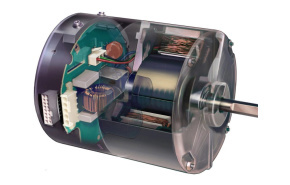


The core principle of an EC (Electronically Commutated) motor is to use electronic components to perform "commutation" instead of traditional mechanical brushes. This process mainly consists of the following three steps:
- AC to DC: First, the motor's built-in controller converts the input alternating current (AC) into direct current (DC).
- Electronic Commutation: Then, the controller acts like a precision dispatcher, monitoring the rotor's position in real-time and precisely controlling the current to flow sequentially through different windings of the stator. The resulting rotating magnetic field drives the permanent magnet rotor to spin continuously.
- Precise Control: The entire process achieves electronic closed-loop control, allowing for precise management of the motor's speed and torque.
Key Advantages of EC Motors (Compared to Traditional AC Motors)
This electronic design gives EC motors significant advantages over traditional AC motors. The following comparison highlights their superior performance:
1. Superior Energy Efficiency & Savings
- Extremely High Efficiency: Meets IE5 efficiency standards, with typical energy savings of over 30%.
- High Efficiency Across All Loads: Maintains high efficiency across a 10% - 100% speed range, overcoming the drawback of traditional motors whose efficiency drops sharply at low speeds.
2. Excellent Control Performance
- Stepless Speed Control: Enables precise, continuously variable speed adjustment.
- High Integration: No external variable frequency drive (VFD) is needed, as the controller is built directly into the motor.
3. Low Maintenance & Long Lifespan
- Maintenance-Free: No brush wear eliminates a primary wear-and-tear part.
- Intelligent Protection: Integrates self-protection functions such as over-temperature, overload, and stall protection.
4. Superior Low-Noise Operation
- Operates very quietly, especially under partial load or at low speeds, without the electromagnetic "hum" characteristic of traditional motors.
5. High Intelligence & Integration
- Functional Integration: Integrates drive, control, and protection functions into one unit.
- Communication & Networking: Standard communication interfaces (e.g., RS485, Modbus) make it easy to connect to other automation control systems for remote monitoring.
Of course, this electronic design also leads to higher costs. However, with the localization of electronic component manufacturing in China, it is believed that this cost will gradually decrease.